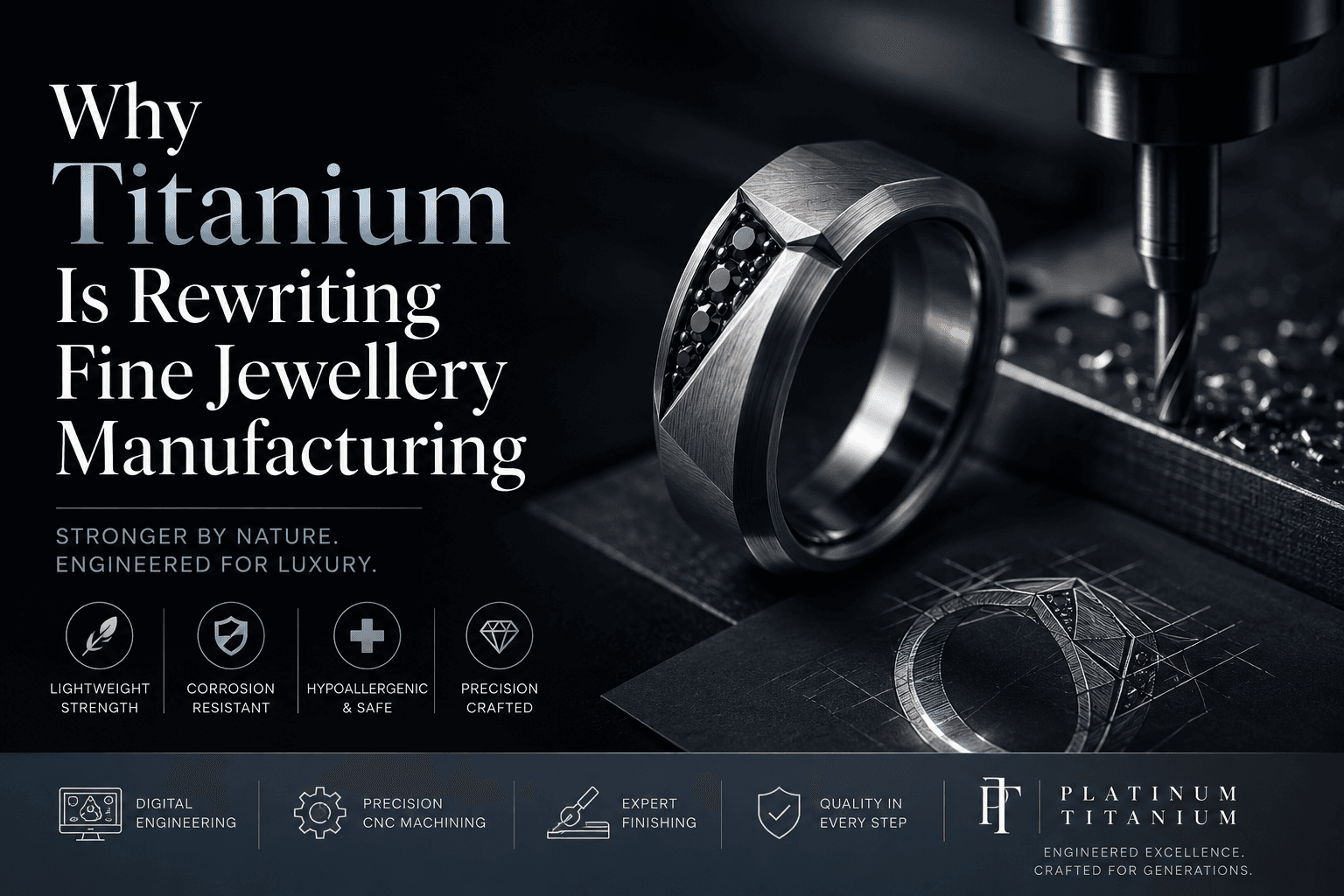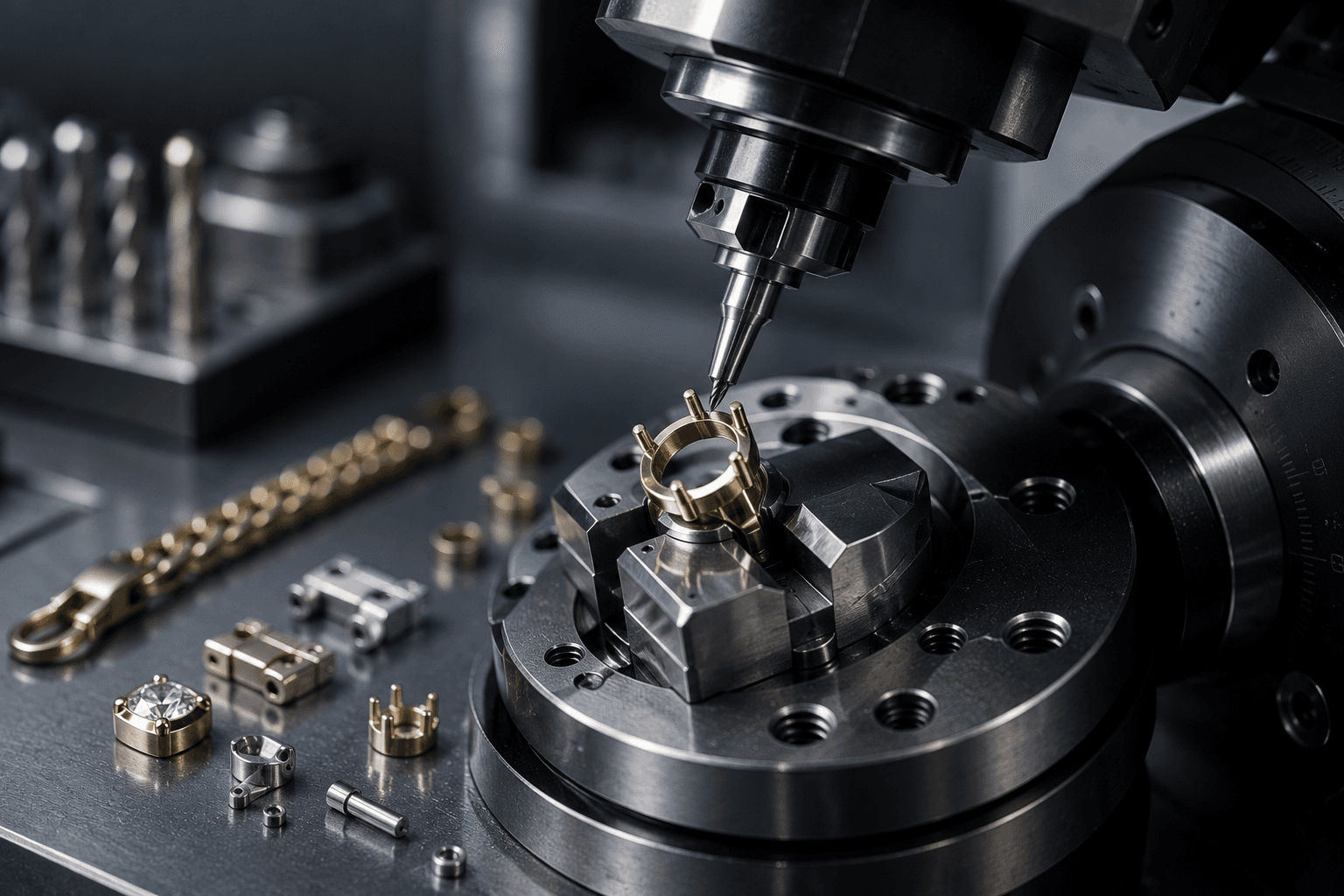

Why Precision CNC Machining Is Transforming Modern Jewellery Manufacturing
Discover how precision CNC machining is revolutionizing luxury jewellery manufacturing through micron-level accuracy, advanced digital engineering, and consistent production quality for titanium and platinum jewellery.
By Platinum Titanium
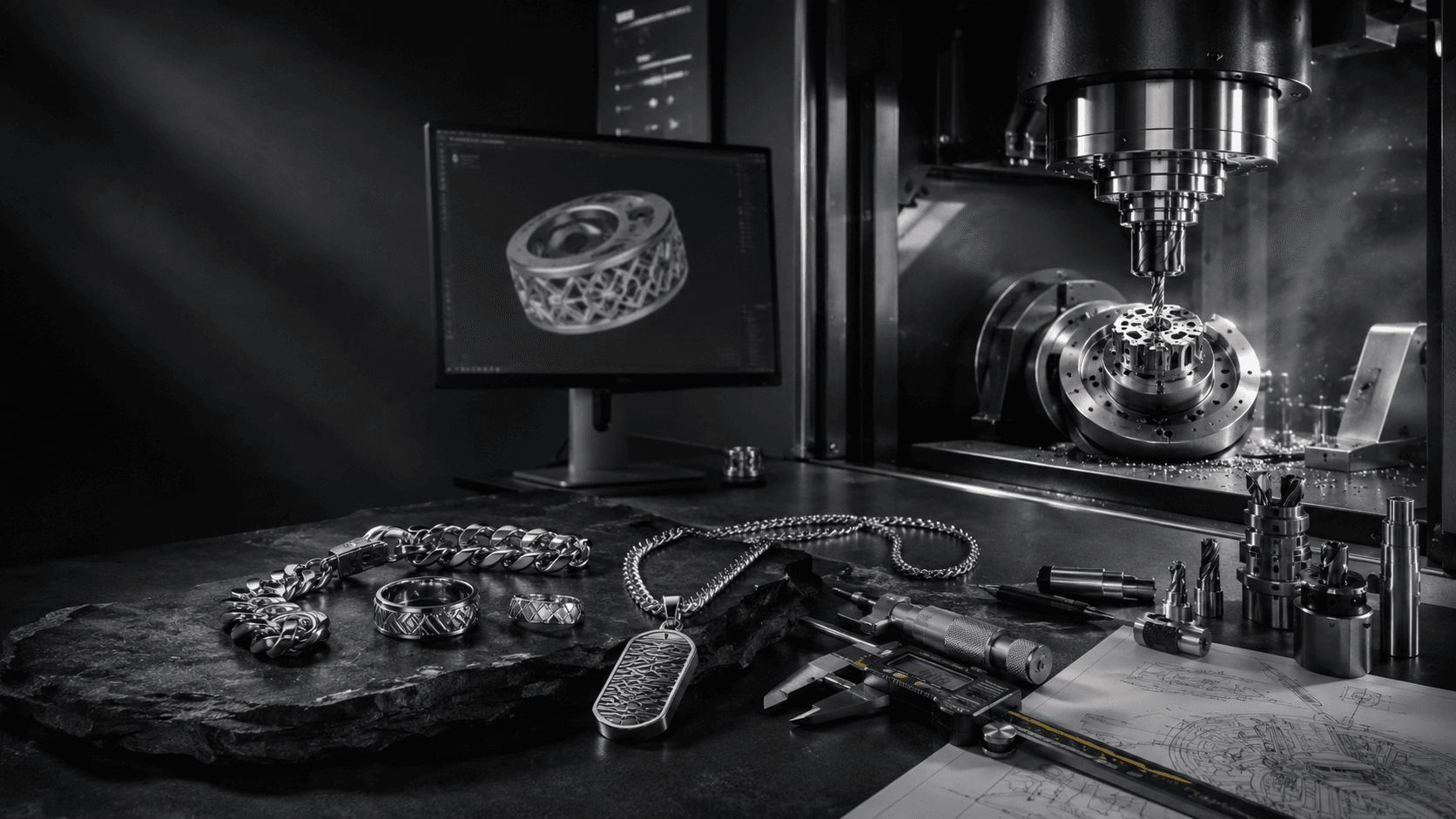
Why Precision CNC Machining Is Transforming Modern Jewellery Manufacturing
Introduction
Luxury jewellery has always been associated with craftsmanship, but today's market demands something more—precision, consistency, and scalability. As jewellery designs become increasingly intricate and customer expectations continue to rise, traditional manufacturing methods alone can no longer meet every requirement.
This is where precision CNC machining is changing the industry.
By combining advanced digital engineering with micron-level manufacturing accuracy, CNC technology enables jewellery manufacturers to produce complex components with exceptional repeatability while maintaining the craftsmanship expected from luxury brands.
At Platinum Titanium, precision machining is at the heart of how we manufacture premium titanium and platinum jewellery components for brands worldwide.
Why Precision Matters in Jewellery
In jewellery manufacturing, even a tiny dimensional error can affect the entire product.
A stone seat that is slightly oversized may fail during setting. A clasp with inconsistent tolerances may not close securely. Multiple small inaccuracies can accumulate throughout production, reducing both quality and customer satisfaction.
Precision manufacturing ensures every component fits exactly as intended.
Benefits include:
Accurate stone settings
Consistent clasp mechanisms
Better assembly fit
Reduced polishing corrections
Improved product longevity
CNC Machining Delivers Consistent Results
Unlike manual machining, CNC (Computer Numerical Control) systems follow digitally programmed toolpaths with exceptional repeatability.
Each production cycle replicates the same machining strategy, allowing manufacturers to produce hundreds—or thousands—of identical jewellery components without sacrificing accuracy.
This consistency is especially valuable for:
Rings
Pendants
Chain components
Clasps
Watch accessories
Custom jewellery collections
Every batch maintains the same dimensional standards, making quality predictable rather than dependent on manual adjustments.
Complex Designs Become Manufacturable
Modern jewellery often features intricate geometries that are difficult—or impossible—to produce using conventional methods.
Multi-axis CNC machining allows cutting tools to approach components from multiple angles, enabling manufacturers to create:
Internal cavities
Precision stone seats
Hidden locking mechanisms
Organic surface contours
Lightweight structural designs
Designers gain greater creative freedom without compromising manufacturability.
Titanium Demands Engineering Expertise
Titanium offers exceptional durability, corrosion resistance, and lightweight performance, making it one of the most desirable materials in premium jewellery.
However, machining titanium requires specialized knowledge.
Its low thermal conductivity generates heat around the cutting edge, increasing tool wear and making machining significantly more challenging than conventional precious metals.
Successful titanium manufacturing depends on:
Optimized cutting parameters
High-performance tooling
Rigid workholding
Controlled machining strategies
Continuous inspection
This combination of engineering and craftsmanship is what enables high-quality titanium jewellery production.
Digital Engineering Improves Every Stage
Every successful manufacturing process begins with accurate digital models.
CAD software allows engineers to validate geometry before production starts, reducing errors and accelerating product development.
Digital workflows provide:
Faster prototyping
Better dimensional accuracy
Efficient material utilization
Reliable production repeatability
Shorter development cycles
For jewellery brands, this means moving from concept to production with greater confidence.
Quality Control Is Continuous
Inspection should never be limited to the final product.
At Platinum Titanium, quality verification is integrated throughout manufacturing to ensure every component meets design specifications.
Typical inspection includes:
Dimensional verification
Surface finish evaluation
Stone seat inspection
Assembly fit testing
Visual quality checks
By identifying deviations early, manufacturers reduce waste, improve efficiency, and maintain consistent quality across every production batch.
Why Jewellery Brands Choose Precision Manufacturing
Brands today are looking for manufacturing partners who can provide more than production capacity.
They need:
Reliable quality
Engineering support
Fast prototyping
Consistent lead times
Scalable production
Precision CNC machining provides the foundation for delivering all of these requirements while maintaining luxury-level craftsmanship.
Partner with Platinum Titanium
At Platinum Titanium, we combine advanced CNC machining, digital engineering, rigorous quality control, and expert finishing to manufacture premium titanium and platinum jewellery components.
Whether you're developing a new collection or scaling production, our team works alongside your designers and engineers to ensure every component meets the highest standards of precision and craftsmanship.
From prototype to production, we help jewellery brands transform innovative ideas into exceptional products.
Conclusion
The future of jewellery manufacturing belongs to companies that successfully combine engineering precision with traditional craftsmanship.
Precision CNC machining is no longer just a competitive advantage—it's becoming the industry standard for producing premium jewellery with consistent quality, complex geometries, and outstanding durability.
As materials like titanium continue to gain popularity, manufacturers that invest in advanced production technologies will lead the next generation of fine jewellery.